
Application solution
Lithium Battery Slurry Processing
Mixing, dispersion, wet grinding, vacuum deaeration, and transfer solutions for consistent cathode, anode, conductive, and ceramic battery material slurries.
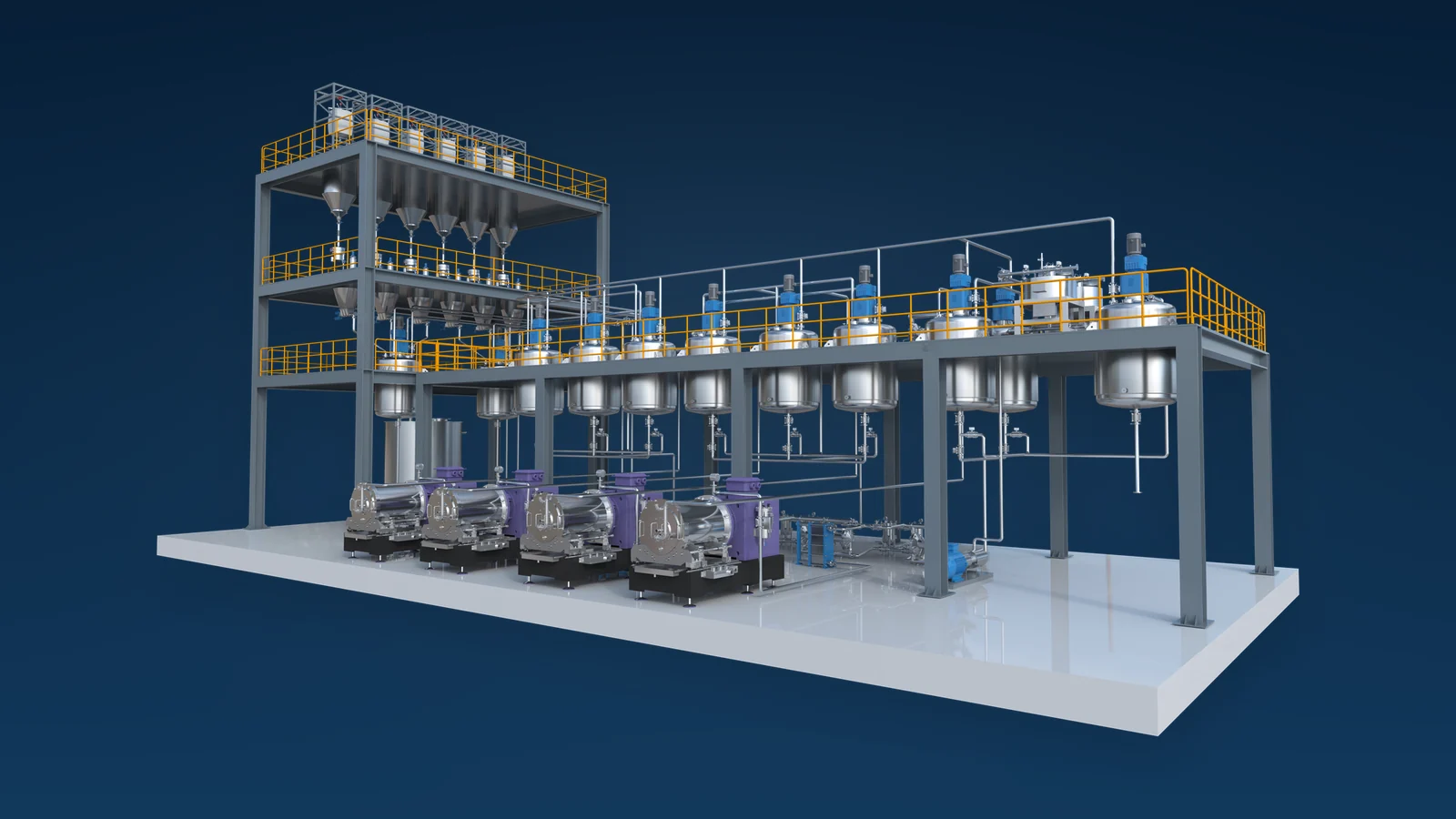
Process Overview
Battery slurry preparation must deliver uniform solids distribution, stable rheology, controlled temperature, and low entrained air before the coating process. These goals are connected: powder addition changes viscosity, mixing energy generates heat, and high shear can introduce gas or alter formulation behavior.
A double planetary mixer provides strong bulk movement and kneading across a wide viscosity range. An optional high-speed disperser can add localized shear for powder wetting and agglomerate breakdown. Vacuum processing, jacket temperature control, controlled dosing, and recipe-based operation help improve repeatability.
The correct process route varies by cathode, anode, conductive, binder, and ceramic formulation. Equipment decisions should therefore be supported by representative material testing, measurable acceptance criteria, and a scale-up plan that links laboratory results to production conditions.
Matching equipment to material behavior
Yushun’s 2026 product knowledge base identifies the double planetary mixer for medium- to high-viscosity slurry discussions. Higher-viscosity or highly elastic materials may warrant evaluation of a vertical planetary kneader. A direct-drive bead mill can be evaluated for grinding materials such as lithium iron phosphate or carbon nanotubes; this does not guarantee compatibility with every formulation or a fixed energy saving.
Line integration and selection inputs
The knowledge base also lists automatic feeding, holding, homogenization, and magnetic-screen filtration equipment. Individual model and specification data still need to be supplied; these are not a finalized line configuration. Provide formulation, solids content, viscosity and measurement conditions, batch size, temperature control, cleanliness, deaeration, and upstream/downstream requirements.
This page supports preliminary process discussions; the edited Chinese content and English technical content require engineering review. Submit your battery slurry requirements.
Common Process Challenges
- Conductive additives and fine powders can form persistent agglomerates that reduce slurry uniformity.
- Viscosity evolves during powder addition and mixing, changing flow, heat transfer, and required torque.
- Entrained air can interfere with coating stability and create downstream electrode defects.
- Metallic contamination, moisture exposure, temperature history, and batch-to-batch variation require careful control.
Recommended Process Approach
- Use a controlled charging sequence and mixing profile that balances powder wetting, bulk turnover, and shear.
- Configure planetary mixing and optional high-speed dispersion for the formulation’s full viscosity range.
- Apply vacuum at appropriate stages with sufficient free volume and foam control to achieve stable deaeration.
- Select contact materials, seals, filtration, instruments, and cleaning procedures around contamination limits.
Equipment options
Recommended Products
Application FAQ
Frequently Asked Questions
Which mixer is suitable for lithium battery electrode slurry?
Selection depends on chemistry, solids loading, binder preparation, conductive additive behavior, viscosity profile, batch size, coating requirements, and plant process. Double planetary mixing is commonly considered for high-viscosity slurry, often with an additional dispersing function.
Why is vacuum processing important?
Vacuum helps remove entrained gas introduced during powder charging and high-shear mixing. Effective deaeration supports stable transfer and coating, but the vacuum profile must account for solvent volatility, foaming, temperature, and vessel freeboard.
When should a bead mill be evaluated?
A bead mill may be evaluated for conductive agents, ceramic separator materials, or other components that require controlled deagglomeration or fine particle processing. Compatibility and electrochemical performance should be validated through application testing.
Engineering consultation
Plan Your Application Test
Tell our engineers about your material, target particle size, viscosity, capacity, and production goals.