Application solution
Paint and Coatings Manufacturing
Integrated powder wetting, pigment dispersion, fine grinding, let-down, and finishing solutions for architectural, industrial, and specialty coating production.
Process Overview
Paint and coatings production typically combines several distinct operations: liquid charging, powder incorporation, predispersing, fine grinding when required, let-down, adjustment, filtration, and filling. Each stage influences final color, gloss, hiding power, viscosity, stability, and manufacturing cost.
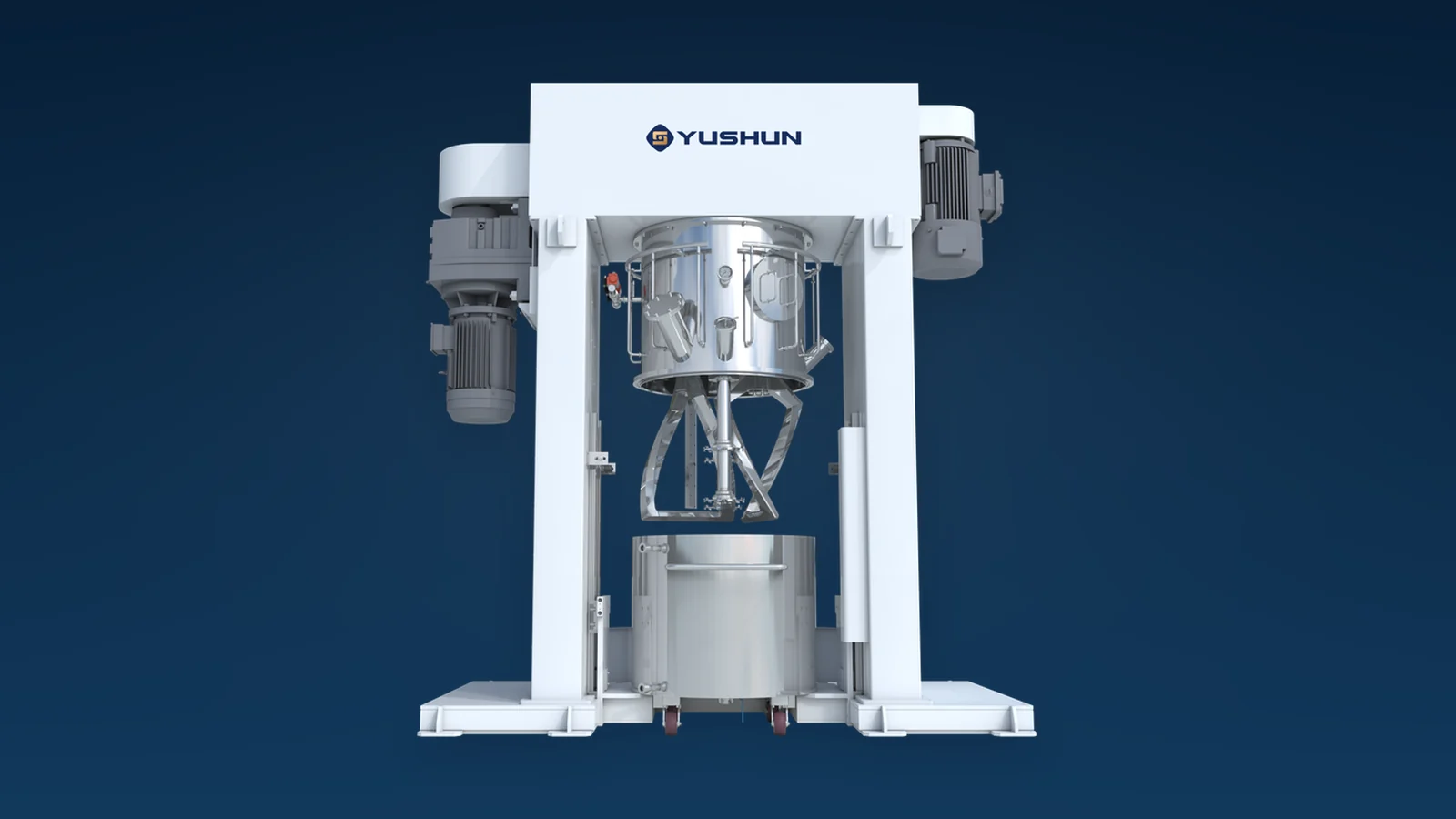
The high-speed disperser is commonly used to wet pigments and fillers and create a consistent mill base. A bead mill can then apply controlled grinding energy to achieve the required particle-size distribution and color development. Let-down and final adjustment may take place in a separate mixing vessel to improve line utilization.
An effective system design considers the complete material path rather than selecting each machine in isolation. Vessel geometry, pump behavior, cooling, piping velocity, filtration, instrumentation, solvent safety, cleaning, and production scheduling all affect real-world performance.
Choosing disc or pin-type equipment
Yushun’s 2026 product knowledge base identifies the disc high-flow bead mill for evaluation where continuous high-flow production is important. The pin-type nano bead mill can be evaluated for finer grinding, narrower particle-size distribution, or stronger shear requirements. These are selection directions, not throughput or particle-size guarantees. Review the resin system, pigments and fillers, temperature rise, contamination limits, and material trials before selection.
Preparing a selection discussion
Include cleaning frequency, installation space, and upstream/downstream transfer and filtration requirements. This page supports preliminary process discussions; the edited Chinese content and English technical content require engineering review.
Common Process Challenges
- Incomplete pigment wetting can create floating powder, long batch times, and unstable color development.
- Agglomerates and broad particle-size distribution can reduce gloss, hiding power, filtration performance, and storage stability.
- Excessive process heat may damage resins, solvents, additives, or color-sensitive formulations.
- Product changeovers can consume significant solvent, labor, and production time.
Recommended Process Approach
- Match disperser power, disc geometry, vessel dimensions, and addition sequence to the formulation rheology.
- Use controlled media milling when the target fineness or color development cannot be achieved by dispersion alone.
- Size cooling surfaces and utilities around actual energy input and the permitted product-temperature window.
- Design piping, vessels, seals, and access points for drainage, cleaning, and repeatable changeover.
Equipment options
Recommended Products
Application FAQ
Frequently Asked Questions
Does every paint formulation require bead milling?
No. Some extender-rich or easily dispersed formulations reach their quality target with high-speed dispersion. Pigmented systems that require higher gloss, stronger color development, finer particles, or improved stability often benefit from bead milling.
Which process data is most useful when selecting equipment?
Provide batch size, density, viscosity through the process, pigment and filler loading, feed fineness, target fineness, required throughput, maximum temperature, solvent classification, cleaning method, and current quality issues.
Can the same line produce different colors?
Yes, but the practical sequence and cleaning design matter. Product family, color sequence, contamination tolerance, line drainage, dead legs, media-mill hold-up, and cleaning solvent should be reviewed before equipment is finalized.
Engineering consultation
Plan Your Application Test
Tell our engineers about your material, target particle size, viscosity, capacity, and production goals.