
Process Fundamentals
High-Speed Disperser vs. Bead Mill: Which Process Do You Need?
Understand the difference between powder wetting, dispersion, deagglomeration, and fine grinding to decide when a disperser, bead mill, or two-stage process is appropriate.
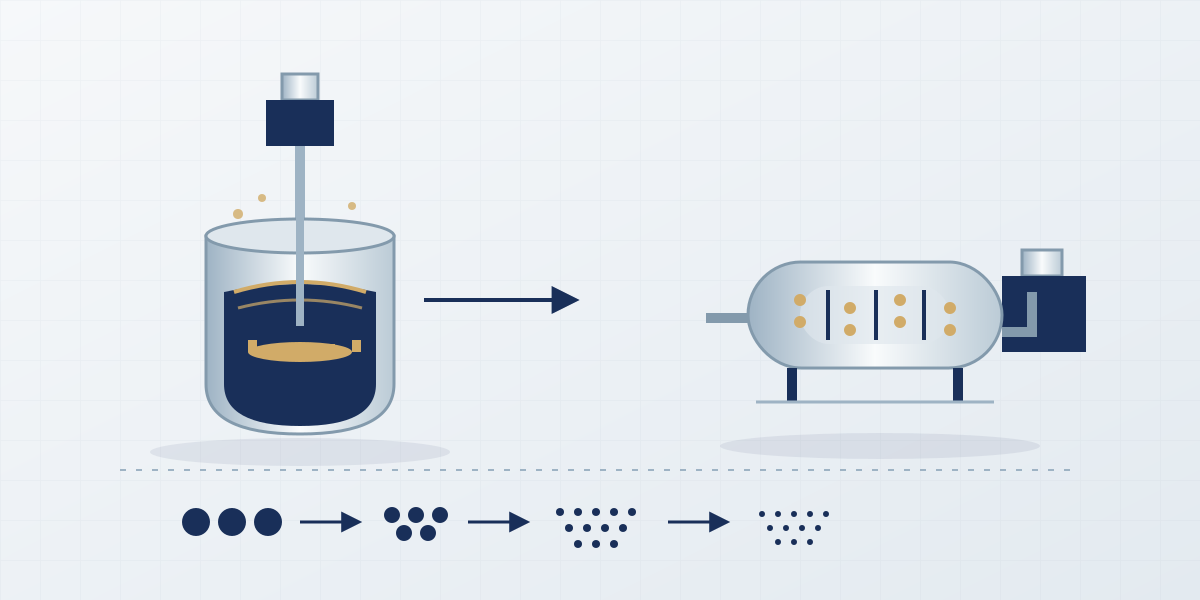
High-speed dispersers and bead mills both apply energy to liquid-solid formulations, but they solve different process problems. Choosing between them starts with understanding the condition of the particles and the quality target—not with comparing motor power.
What a High-Speed Disperser Does
A disperser creates rapid circulation and high local shear around a toothed disc. Its primary jobs are to draw powder into the liquid, replace air around particle surfaces with the liquid phase, distribute ingredients, and break relatively weak agglomerates.
For many coatings, adhesives, and chemical formulations, this is enough to achieve the required uniformity. The result depends on disc tip speed, vessel geometry, liquid depth, powder addition rate, viscosity, and batch temperature.
What a Bead Mill Adds
A bead mill passes the formulation through a chamber filled with grinding media. Collisions and shear within the moving media bed apply much higher localized stress than a conventional disperser. This can break stronger agglomerates and, in suitable applications, reduce primary particle size.
Bead milling is often considered when the formulation requires finer particles, improved color development, higher gloss, a narrower distribution, or performance that high-speed dispersion alone cannot deliver.
Why Predispersion Still Matters
A bead mill normally performs best with a consistent, pumpable feed. Dry pockets, oversized agglomerates, unstable viscosity, or poorly wetted powder can reduce throughput, cause pressure instability, and increase wear. A high-speed disperser is therefore commonly used to prepare the mill base before fine grinding.
Use a Measurable Decision Rule
Define the target using relevant data: particle-size distribution, fineness of grind, color strength, gloss, filtration result, stability, viscosity, or application performance. Run a controlled disperser trial first. If the target is not reached within an acceptable time and temperature window, evaluate bead milling.
For difficult formulations, a two-stage process often provides the best balance: efficient powder incorporation and initial deagglomeration in the disperser, followed by controlled fine grinding in the bead mill.
Equipment and Trial Planning
Review the high-speed disperser and laboratory bead mill, then use the laboratory bead mill selection guide to prepare trial data.
A Chinese edition of this technical article is now available with the original publication date retained. The translation and process recommendations require engineering review and are not throughput or particle-size guarantees. Discuss dispersion and grinding.
Engineering consultation
Need Help With Your Process?
Tell our engineers about your material, target particle size, viscosity, capacity, and production goals.