
Equipment Selection
How to Select a Laboratory Bead Mill
A practical guide to evaluating chamber volume, grinding media, separation, cooling, material compatibility, and scale-up before choosing a laboratory bead mill.
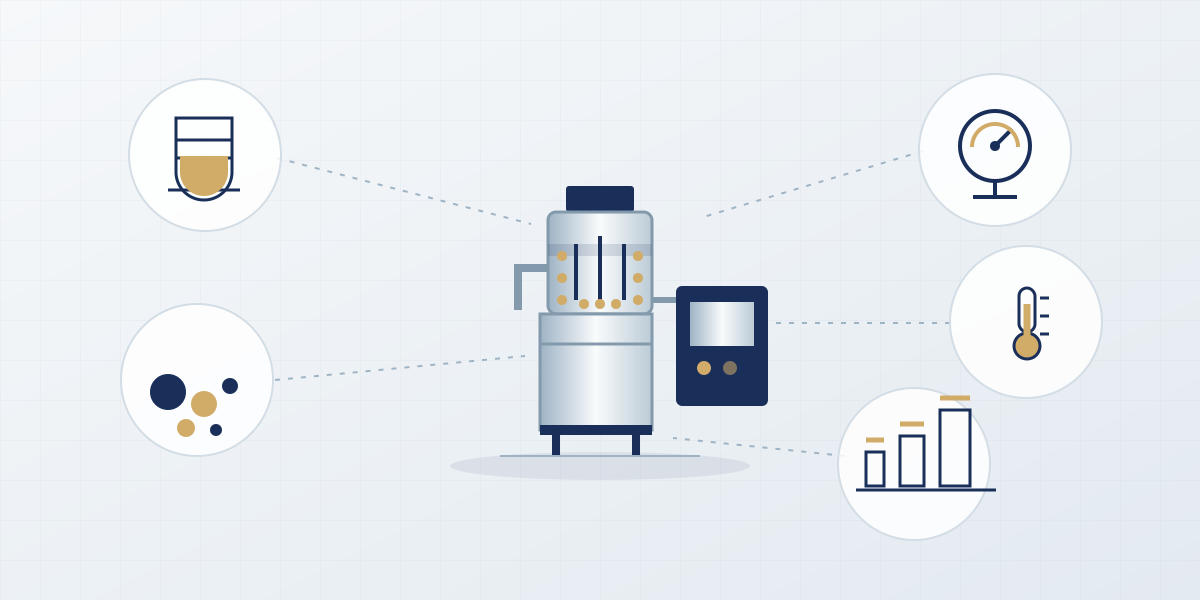
A laboratory bead mill is not simply a smaller production mill. It is a development tool that should generate useful process data while consuming a manageable amount of material. The right selection depends on what you need to learn, the formulation you need to protect, and how the results will support scale-up.
Start With the Test Objective
Define the decision the test must support. Common objectives include comparing formulations, screening grinding media, establishing achievable particle size, measuring color development, checking temperature sensitivity, or estimating the specific energy required for production.
A clear objective determines the sampling plan, instruments, material quantity, and machine configuration. It also prevents a visually successful trial from producing data that cannot be used for scale-up.
Evaluate the Complete Material Loop
Chamber volume is only one part of minimum batch size. Piping, pump, recirculation vessel, sampling points, and product retained during drainage all contribute to system hold-up. If the test material is expensive, ask for the total practical charge rather than only the nominal grinding-chamber volume.
Viscosity and flow behavior also affect the loop. A pump that handles a low-viscosity ink may not provide stable feed for a dense, shear-sensitive slurry.
Match Media and Separation
Grinding media material, diameter, density, quality, and filling level influence energy transfer, contamination, wear, and final particle size. The separator must reliably retain the selected media while allowing the product to flow without excessive pressure or blockage.
Smaller media is not automatically better. The feed must be fine enough to enter the media bed, and the formulation must remain stable as new surface area is created.
Plan for Heat Removal
Most energy delivered to a bead mill eventually becomes heat. A useful laboratory trial therefore needs repeatable cooling-water conditions and accurate product-temperature records. If temperature drifts between tests, formulation viscosity and grinding behavior may also change, making comparisons unreliable.
Build a Scale-Up Data Set
Record formulation, feed particle size, media specification, filling level, rotor speed, flow rate, batch mass, temperature, pressure, processing time, and power or energy when available. Sample at planned intervals and use the same measurement method for every trial.
The best laboratory bead mill is the one that produces both the required material result and the data needed for the next engineering decision.
Continue Your Selection Discussion
Review the laboratory bead mill reference configurations and disperser vs. bead mill comparison to assess predispersion requirements.
A Chinese edition of this technical article is now available with the original publication date retained. The translation and process recommendations require engineering review and are not throughput or particle-size guarantees. Submit your material trial requirements.
Engineering consultation
Need Help With Your Process?
Tell our engineers about your material, target particle size, viscosity, capacity, and production goals.