
Technical Articles
Scaling Up High-Viscosity Composites With a Vertical Kneader
Explore how blade motion, temperature control, vacuum, and discharge affect the scale-up of high-viscosity composites, and what to validate before production.
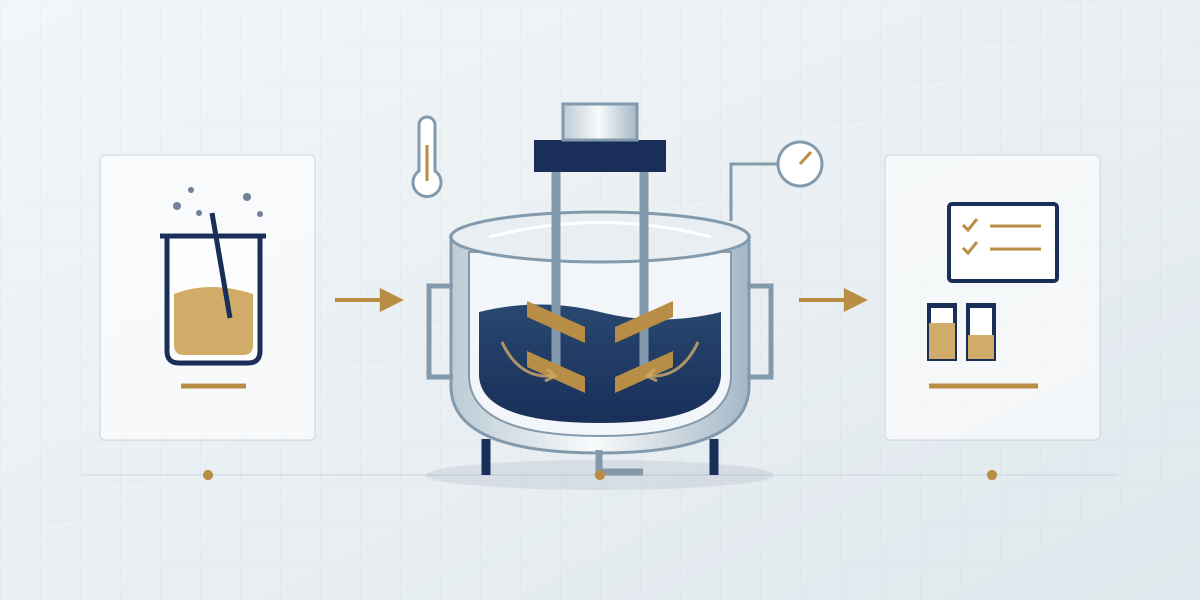
A composite formulation may mix well in a laboratory beaker yet form persistent lumps when transferred to production. Scaling up requires more than a larger vessel: the equipment must move the entire batch, wet out the ingredients, manage heat, and support reliable discharge.
A vertical kneader uses configured blade motion to work viscous or elastic materials through compression, stretching, shearing, and folding. Its suitability depends on the formulation, blade arrangement, drive capacity, thermal control, vacuum system, and discharge method. Material trials help establish the configuration and operating window.
Why Laboratory Results Can Be Difficult to Reproduce
Composite performance depends on uniform distribution of ingredients that may have very different physical properties. Examples include polymer resins combined with fibers or fine thermally conductive fillers.
As solids are added, viscosity can rise substantially. Some formulations reach tens of thousands or more than a million centipoise (cP), while others behave as elastic pastes. These examples describe material behavior, not a guaranteed operating range for every kneader. Viscosity must be assessed at the relevant temperature and measurement conditions.
Three common problems become harder to manage during scale-up:
- Agglomeration: powders may form clusters that are difficult to wet and distribute throughout the batch.
- Entrained air: bubbles can become trapped in a viscous mass and may be difficult to remove.
- Insufficient bulk movement: a mixer may move material near the blades without effectively circulating the whole batch, placing additional demand on the drive.
Increasing speed alone may increase heat or damage sensitive ingredients. The required balance of bulk movement, shear, and temperature control should be established through testing.
Composite Applications and Configuration Priorities
Fiber-Reinforced Resin Systems
For epoxy formulations containing carbon or glass fibers, the process must balance wetting and distribution against fiber damage. Blade geometry, motion, and the mixing sequence need to be evaluated with the actual reinforcement.
In formulations used for prepreg production, successful resin preparation does not by itself verify the downstream impregnation process. Trials should assess the relevant material quality and fiber integrity rather than relying only on visual uniformity.
Thermally and Electrically Conductive Composites
Adding alumina, boron nitride, or carbon nanotubes to silicone or polymer matrices can make mixing increasingly demanding as filler loading rises. Compression and folding can help incorporate powders and renew the material exposed to mixing action.
Potential applications include electronic encapsulation materials and thermally conductive adhesives used in battery assemblies. The required dispersion, conductivity, and final properties depend on the formulation and must be verified with suitable measurements.
Special Engineering Polymers
The domestic article also discusses high-temperature blending of engineering polymers such as polyether ether ketone (PEEK) and polyimide (PI). These materials have different thermal behavior and processing routes; not all grades can be treated as melt-processable polymers. For background, see Victrex's PEEK processing guidance and DuPont's Vespel polyimide design handbook.
For such applications, confirm the resin grade, processing temperature, residence time, atmosphere, and reaction requirements with the engineering team. High-temperature capability is a project-specific configuration and must not be assumed from the equipment name alone.
How Vertical Kneader Configuration Addresses Production Challenges
Layout, Sealing, and Atmosphere Control
A vertical layout can be considered when floor space and access are important. The practical footprint includes the vessel, lifting or tilting envelope, feeding equipment, utilities, and maintenance clearance.
Where vacuum or an inert atmosphere is required, sealing suitability should be evaluated for the actual material, operating conditions, and agreed leak-test criteria. A vertical arrangement alone does not establish a sealing guarantee.
Discharge and Cleaning
Viscous materials may adhere to the vessel and remain difficult to discharge. Yushun's existing vertical planetary kneader configurations include hydraulic vessel tilting and ball-valve discharge options, selected according to the process.
Evaluate discharge behavior using representative material. Confirm acceptable residue, access for cleaning, changeover requirements, and the next process step. Batch evacuation time and residue cannot be specified reliably without the selected configuration and test conditions.
Balancing Kneading Action and Shear
Configured blade motion can combine compression, stretching, shearing, and folding to move a viscous batch. The blade arrangement and relative motion must be confirmed for the specific machine; different kneader designs should not be assumed to use the same mechanism.
For elastic formulations, viscosity alone is not enough to select equipment. Assess solids content, elasticity, torque demand, temperature sensitivity, and the effect of mixing on the ingredients. Compare the vertical planetary kneader with the double planetary mixer when discussing the required process action.
Temperature, Process Records, and Vacuum
Jacket heating or cooling can support temperature control. Where PLC and touchscreen controls are specified, agree which parameters are measured and recorded, including temperature, motor current, speed, and process time. Confirm whether trends can be exported in the required format.
Temperature monitoring helps manage the risk of local overheating or premature resin cure. Monitoring does not replace an assessment of heat generation and heat removal at production scale.
A suitably configured vacuum system can assist air removal during an appropriate part of the mixing sequence. Its performance depends on the formulation and operating conditions. Establish the degassing procedure through trials, and confirm any documentation or traceability requirements in the project specification.
What to Validate Before Production Scale-Up
Use a representative material trial to establish the process window. Provide:
- Resin or binder type, filler or fiber characteristics, solids content, and addition sequence.
- Viscosity and elastic behavior at the intended processing temperature, with the measurement method.
- Target working batch size and the required degree of dispersion or uniformity.
- Temperature limits, vacuum or atmosphere requirements, and ingredient sensitivity to shear.
- Discharge behavior, acceptable residue, cleaning needs, and downstream handling.
- Sampling methods, acceptance criteria, and the process records needed for repeatability.
Compare laboratory and pilot results using the same quality measurements. Keep a record of the formulation, sequence, operating conditions, and batch outcome so that the production configuration can be reviewed against evidence.
Discuss Your Composite Mixing Requirements
Composite quality comes from the interaction of formulation, process, and equipment. A vertical kneader can be evaluated as part of that system when uniformity, discharge, or cleaning becomes difficult at production scale.
Explore the high-viscosity mixing solution, review the vertical planetary kneader, or send your material and scale-up requirements to Yushun.
Adapted for international readers from Yushun's Chinese technical article published July 17, 2026. English edition prepared October 14, 2026. Technical terminology and application suitability require engineering review; final equipment capability and acceptance criteria are agreed for the specific project.
Engineering consultation
Need Help With Your Process?
Tell our engineers about your material, target particle size, viscosity, capacity, and production goals.