
Process solution
High-Viscosity Mixing Solution
Plan high-viscosity mixing, dispersion, kneading, vacuum, temperature control, discharge, cleaning, and automation around the actual material behavior.
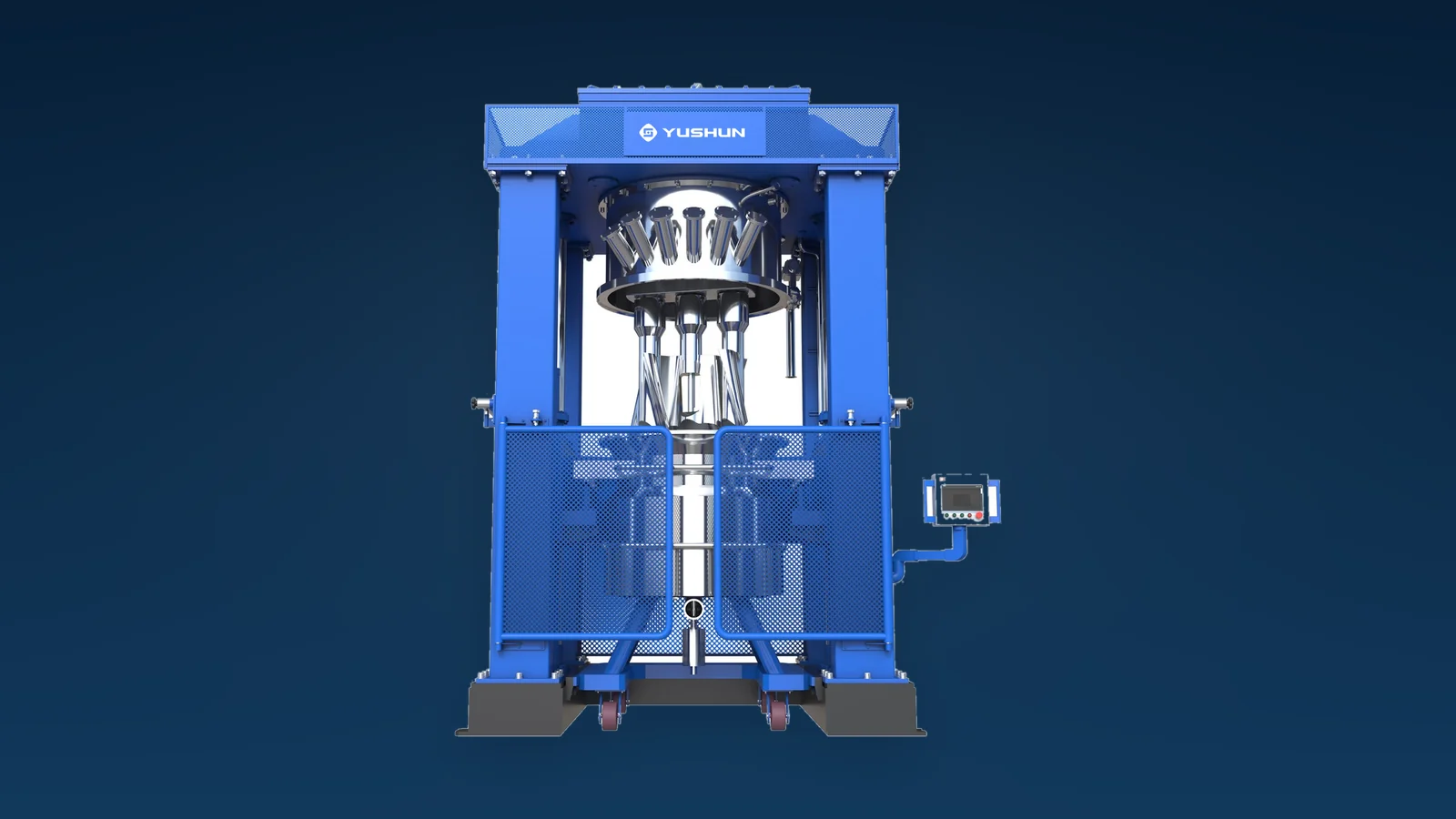
Prepared from Yushun’s 2026 product knowledge base and existing double planetary mixer and vertical planetary kneader data. Viscosity ranges are preliminary selection references, not universal equipment limits. Final configuration and acceptance criteria require material evaluation, trials when appropriate, and an approved technical agreement.
Solution Overview
Process flow
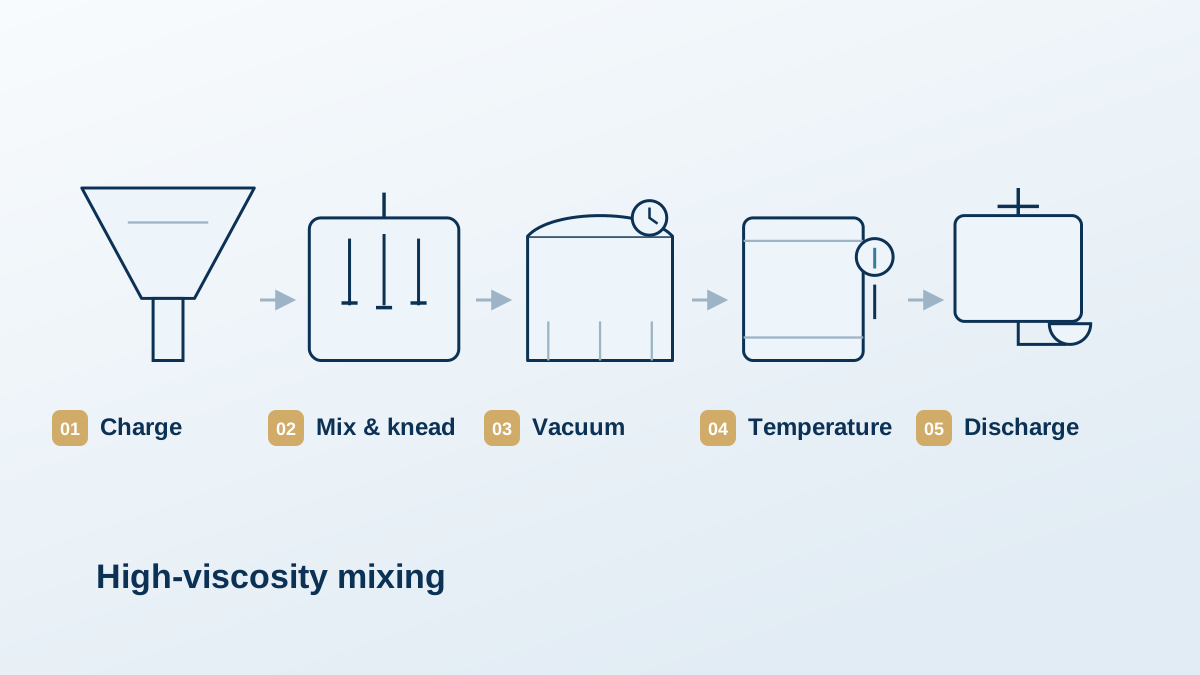
The diagram shows the order of the process steps only. Equipment configuration, capacity and parameters are confirmed per material and project.
What is a high-viscosity mixing solution?
A high-viscosity mixing solution coordinates more than the rotating tool inside a vessel. It connects material charging, planetary mixing or kneading, optional high-speed dispersion, vacuum deaeration, temperature control, discharge, transfer, cleaning, and process controls around the formulation’s changing behavior.
The objective is to obtain a repeatable process without treating one viscosity value as the entire specification. Solids content, elasticity, thixotropy, heat generation, foaming, permitted contamination, batch size, and discharge behavior can all change the correct equipment and operating sequence.
How is the mixing action selected?
A double planetary mixer can be evaluated for flowable medium- to high-viscosity materials that require mixing, dispersion, homogenization, and vacuum processing. The current product data lists approximately 10,000–1,000,000 cP as a preliminary reference range, but the actual limit remains formulation- and configuration-specific.
A vertical planetary kneader can be compared when elasticity, torque demand, kneading action, or discharge difficulty becomes more demanding. Its product data lists approximately 10,000–2,000,000 cP as a preliminary reference range. These ranges overlap and do not replace material evaluation.
How do vacuum, temperature, and discharge affect the process?
Vacuum can support deaeration, but its timing must account for foaming, volatile components, vessel headspace, seals, and the process stage. Heating or cooling duty must be based on the material temperature limit and energy introduced during mixing. Discharge must be planned early because vessel lifting, tilting, valve discharge, transfer equipment, residue, and cleaning can determine whether the process is practical.
How should the solution be validated?
Start with a representative material sample and measurable objectives for uniformity, temperature, vacuum, dispersion or kneading, discharge, residue, and cleaning. Laboratory-scale trials may support early comparisons when their scale and material range are appropriate, while production-scale mixer or kneader selection requires an engineering review.
Review the lithium battery slurry application, or submit your material and process requirements for a preliminary discussion.
Engineering sequence
How the process is planned
01
Characterize the material through the batch
Review viscosity development, solids content, elasticity, thixotropy, temperature sensitivity, entrained air, contamination limits, and how the material changes from charging to discharge.
02
Select the mixing or kneading action
Compare planetary mixing and dispersion with higher-torque kneading according to material flow, required uniformity, powder incorporation, deaeration, and process sequence.
03
Plan vacuum and thermal control
Define vacuum timing, vessel headspace, seal requirements, heating or cooling duty, temperature limits, instrumentation, and safeguards for the formulation.
04
Engineer discharge and cleaning
Evaluate vessel lifting or tilting, valve discharge, downstream transfer, retained material, cleaning access, changeover, automation interfaces, and operator handling.
Selection basis
Information needed for evaluation
- Material name, formulation, solids content, and density
- Viscosity profile, elasticity, thixotropy, and flow behavior
- Batch size, working volume, charging sequence, and cycle objective
- Required mixing, dispersion, kneading, homogenization, and deaeration results
- Maximum product temperature and available heating or cooling utilities
- Vacuum requirements, foaming tendency, and volatile components
- Permitted contamination and required contact materials
- Discharge behavior, residual-material limit, and downstream transfer method
- Cleaning, changeover, safety, and automation requirements
Application context
Related applications
Solution FAQ
Frequently Asked Questions
What is a high-viscosity mixing solution?
It is a coordinated process for charging, mixing or kneading, dispersion when required, vacuum deaeration, temperature control, discharge, cleaning, and control of materials whose flow changes significantly during production.
How do I choose between a double planetary mixer and a vertical planetary kneader?
A double planetary mixer can be evaluated for flowable medium- to high-viscosity materials that require mixing, dispersion, homogenization, and vacuum processing. A vertical planetary kneader can be compared for materials with greater elasticity, torque demand, or discharge difficulty. Viscosity alone is not sufficient for selection.
Is a published viscosity range an equipment guarantee?
No. Published ranges are preliminary selection references. Actual suitability depends on the complete formulation, solids content, elasticity, temperature, batch size, blade arrangement, torque, discharge behavior, and agreed operating conditions.
Why must discharge be considered before selecting the mixer?
A material can mix successfully but remain difficult to remove or transfer. Vessel lifting or tilting, valve discharge, downstream pumps, residual-material limits, cleaning access, and operator handling should therefore be evaluated with the mixing stage.
Can material trials support equipment selection?
Yes. Representative trials can compare powder incorporation, mixing or kneading behavior, temperature, vacuum deaeration, uniformity, discharge, and cleaning. Scale-up still requires an engineering review and agreed acceptance conditions.
Engineering consultation
Discuss Your Process Solution
Tell our engineers about your material, target particle size, viscosity, capacity, and production goals.