
Technical Articles
Evaluating Planetary Mixing for Dental Composite Materials
Review viscosity, solids loading, product-contact requirements, blade selection, vacuum, and trials when evaluating mixing equipment for dental composite formulations.
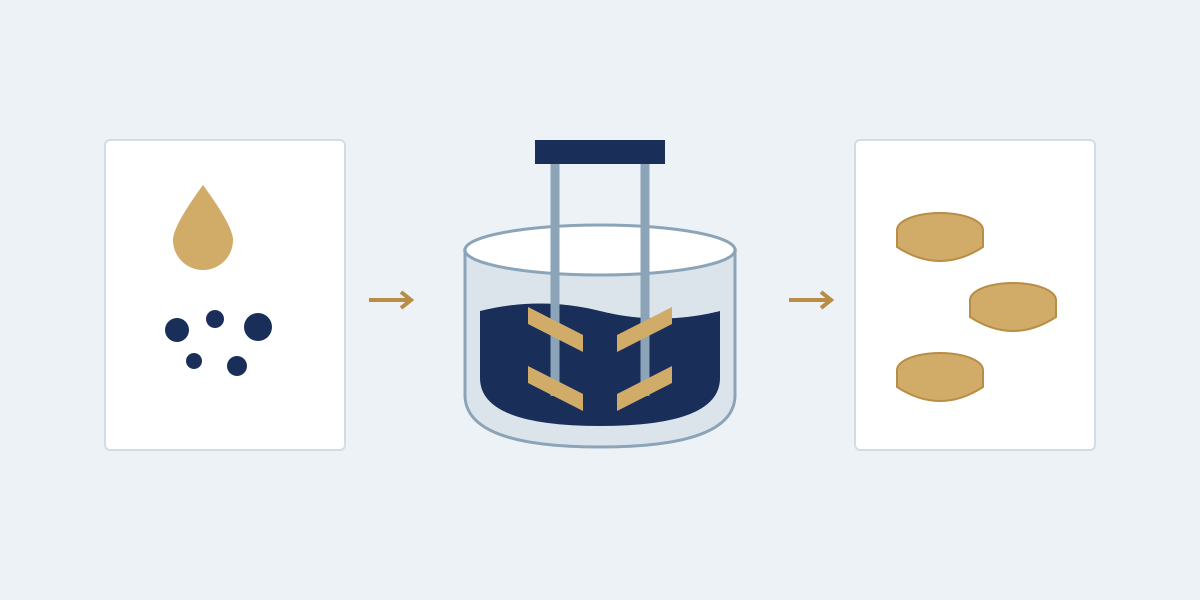
Composite formulations combine ingredients with different properties. Yushun's domestic article uses dental materials as an example of a mixing application where viscosity, solids loading, and product-contact requirements influence equipment selection.
This article explains the general processing questions. It does not establish the clinical performance or regulatory suitability of a dental material or a particular mixer configuration.
Begin With Material Behavior
Establish the viscosity and solids content at the relevant processing conditions. Describe how the material changes as ingredients are added and identify temperature or shear sensitivity.
These inputs help determine whether planetary mixing provides the required bulk movement. They also influence blade shape, drive configuration, working batch size, and the handling of material after mixing.
Define Product-Contact and Contamination Requirements
The source highlights a formulation with restrictions on contact with metal. For a new project, define the actual restriction and how it will be checked, rather than assuming that a standard metal construction or a coating is suitable.
Review the complete product-contact path: vessel, blades, scraping features, seals, discharge, transfer, and sampling. The material specification and cleaning method must be assessed together.
Claims about a coating's grade or suitability require the relevant project documentation. A general label should not be used as a substitute for a defined material and acceptance specification.
Match Blades, Clearances, and Drive Configuration
Planetary blades combine rotation and revolution to move material through the batch. Blade forms and clearances should be selected for the formulation and the required mixing action.
Wall or bottom scraping can help return accumulated material to the mixing zone where included in the configuration. Evaluate its effect on uniformity, residual material, wear, and cleaning.
Where dispersion is required, assess the added action and its effect on the ingredients. Historical speed, noise, component-life, or assembly figures in a product description should not be transferred to a new machine without an approved specification.
Coordinate Vacuum and Temperature Control
Vacuum can be considered where the formulation needs deaeration. Confirm the sealing arrangement, pressure reference, test conditions, and required material result.
Heating or cooling should support the formulation's temperature limits. The trial should record temperature alongside mixing stages so the results can be compared and used during scale-up.
Include Discharge in the Material Trial
The trial is not finished when the material looks mixed. Assess whether the batch can be removed and handled using the intended discharge route and whether residue or cleaning affects the next batch.
Depending on material behavior, discuss the double planetary mixer, vertical planetary kneader, and a combined mixing and press-discharge approach as separate configuration questions.
Supply the formulation characteristics, batch size, product-contact limits, temperature requirements, quality measurements, and discharge needs. Discuss your composite processing requirements or explore the high-viscosity mixing solution.
Adapted from Yushun's domestic composite mixing article, displaying July 10, 2024. Prepared October 14, 2026. Confirm application suitability, material specifications and acceptance criteria with the engineering team.
Engineering consultation
Need Help With Your Process?
Tell our engineers about your material, target particle size, viscosity, capacity, and production goals.