
Process solution
Wet Grinding and Dispersion Solution
Plan powder wetting, pre-dispersion, bead milling, cooling, transfer, filtration, and controls around your material and production requirements.
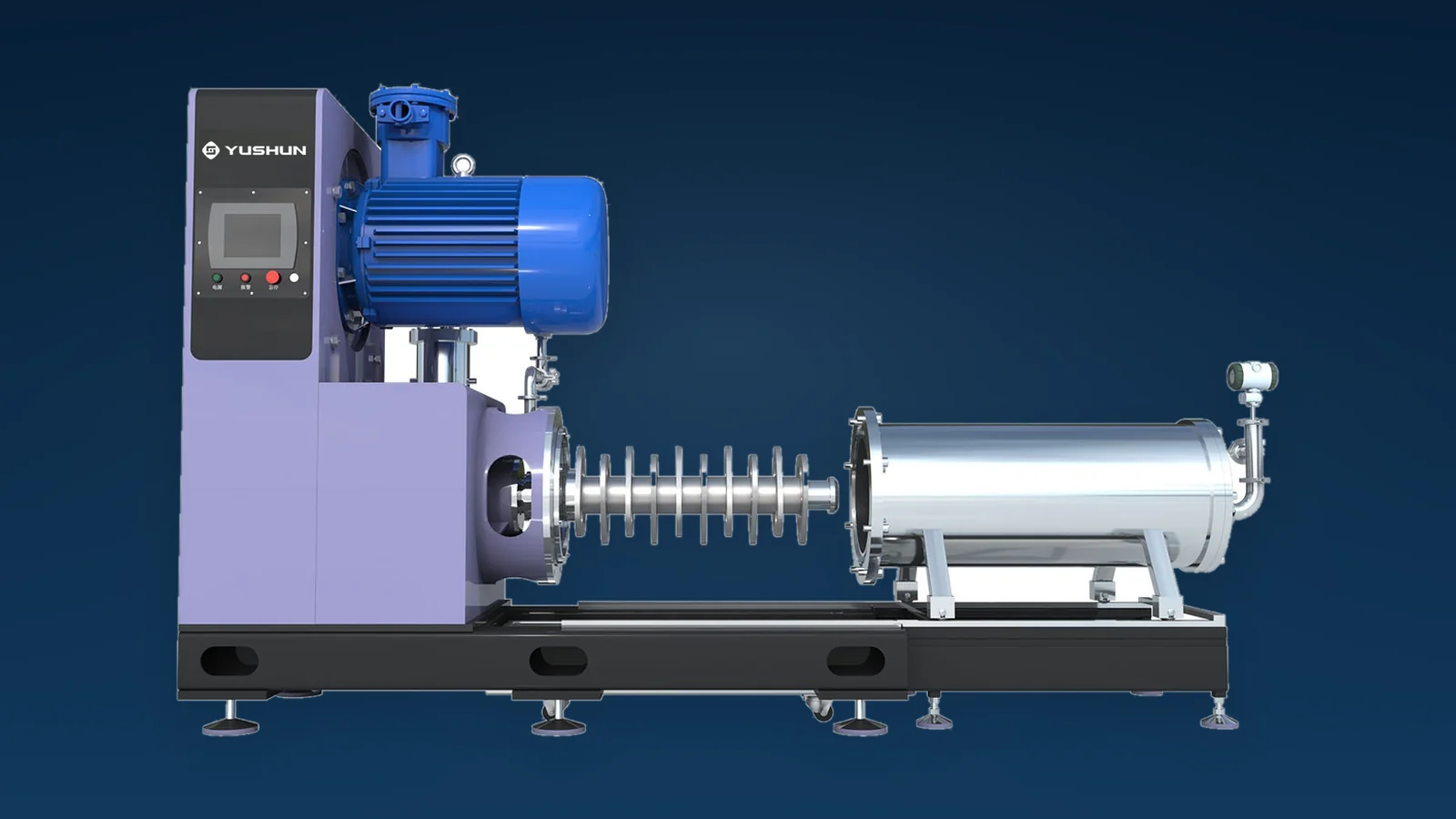
Prepared from Yushun’s 2026 product knowledge base and existing product data. This page supports preliminary process discussions; final equipment, safeguards, and performance criteria require material testing and an approved technical agreement.
Solution Overview
Process flow
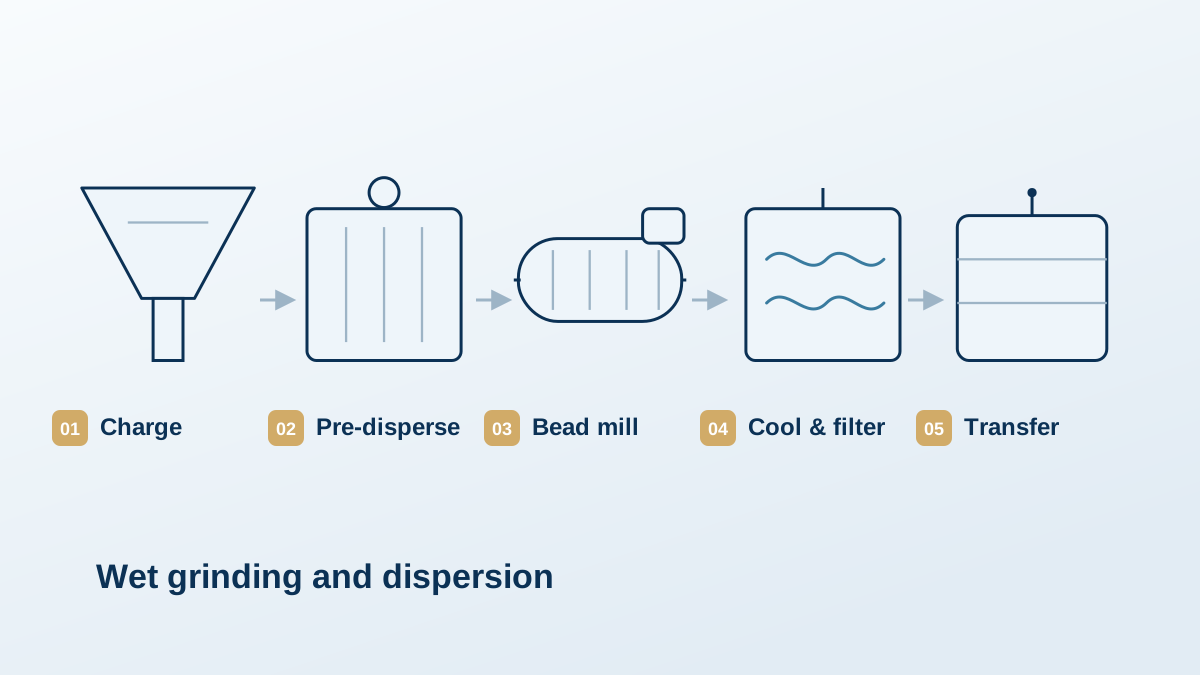
The diagram shows the order of the process steps only. Equipment configuration, capacity and parameters are confirmed per material and project.
What is a wet grinding and dispersion solution?
A wet grinding and dispersion solution connects each operation from powder addition to the finished slurry. Instead of selecting a disperser or bead mill in isolation, the process is evaluated as one material path: charging, wetting, pre-dispersion, milling when required, cooling, transfer, filtration, cleaning, and downstream handling.
The objective is not simply to install more equipment. It is to match energy input, residence time, flow behavior, temperature control, contact materials, and operating sequence to the actual formulation and production target.
How the process works
A high-speed disperser can incorporate powders into the liquid phase and create a consistent pre-dispersion. When the target requires further deagglomeration or particle-size reduction, the material can pass through a bead mill selected for the required shear, flow, cooling, separation, and contamination limits. Final mixing, adjustment, filtration, and transfer are then coordinated with the upstream process.
For development and scale-up, a laboratory bead mill can be used to compare process conditions before a production configuration is finalized. Laboratory results remain material-specific and do not by themselves guarantee production throughput.
How to choose the grinding stage
A disc high-flow bead mill can be evaluated when continuous flow and production capacity are priorities. A pin-type nano bead mill can be compared for stronger shear or more demanding particle-size control. A turbine bead mill may be considered for flexible wet grinding of suitable low- to medium-viscosity slurries. Final selection requires the actual material and operating limits.
High-speed dispersion versus bead milling
High-speed dispersion mainly addresses powder wetting, rapid mixing, and soft-agglomerate breakup. Bead milling uses grinding media to provide further deagglomeration and particle-size reduction. Some formulations need only dispersion; others use both stages. The decision should be based on measured product quality rather than equipment names.
Review the paint and coatings application and lithium battery slurry application for industry-specific considerations, or send your process requirements for a preliminary discussion.
Engineering sequence
How the process is planned
01
Define the material and target
Review formulation, solids content, feed and target particle size, viscosity, temperature limit, contamination tolerance, capacity, and cleaning requirements.
02
Wet and pre-disperse powders
Select the charging sequence, vessel geometry, disperser power, disc configuration, and operating window needed to create a consistent mill base.
03
Evaluate controlled bead milling
Compare laboratory results and production objectives to select mill structure, chamber size, grinding media, cooling, separation, and contact materials.
04
Integrate transfer and finishing
Coordinate pumps, piping, filtration, let-down or final mixing, instrumentation, cleaning access, automation, and downstream handling.
Selection basis
Information needed for evaluation
- Material name, formulation system, and solids content
- Feed particle size, target particle size, and quality criteria
- Viscosity and its response to temperature or shear
- Batch volume or required hourly throughput
- Maximum product temperature and available cooling utilities
- Corrosiveness, solvent classification, and project safety requirements
- Permitted metal contamination and preferred contact materials
- Cleaning frequency, changeover requirements, and installation space
Equipment options
Recommended equipment
Application context
Related applications
Solution FAQ
Frequently Asked Questions
What is a wet grinding and dispersion solution?
It is a coordinated process for powder incorporation, wetting, pre-dispersion, particle-size reduction when required, cooling, transfer, filtration, and process control. The correct equipment sequence depends on the formulation and target result.
Does every formulation require a bead mill?
No. Some materials reach their quality target through controlled mixing or high-speed dispersion. Bead milling is evaluated when the required particle-size distribution, color development, stability, or deagglomeration cannot be achieved by dispersion alone.
How should a bead mill be selected?
Compare the material, feed and target particle size, viscosity, throughput, temperature limit, contamination tolerance, grinding media, cooling duty, cleaning, and safety requirements. Laboratory testing should be used when the formulation or scale-up risk is significant.
What is the difference between a high-speed disperser and a bead mill?
A high-speed disperser primarily wets powders and breaks soft agglomerates through shear and circulation. A bead mill applies energy through grinding media for further deagglomeration and particle-size reduction. They are often used as sequential operations rather than substitutes.
Can Yushun provide more than individual machines?
Yushun can support material trials, equipment selection, process planning, automation integration, and project delivery. The exact scope, site services, performance criteria, and responsibilities must be defined in the project technical and commercial agreements.
Engineering consultation
Discuss Your Process Solution
Tell our engineers about your material, target particle size, viscosity, capacity, and production goals.