
Technical Articles
Double Planetary Mixing in Battery Slurry Preparation
Understand bulk mixing, localized dispersion, solids content, viscosity, and transfer requirements when evaluating a double planetary mixer for electrode slurries.
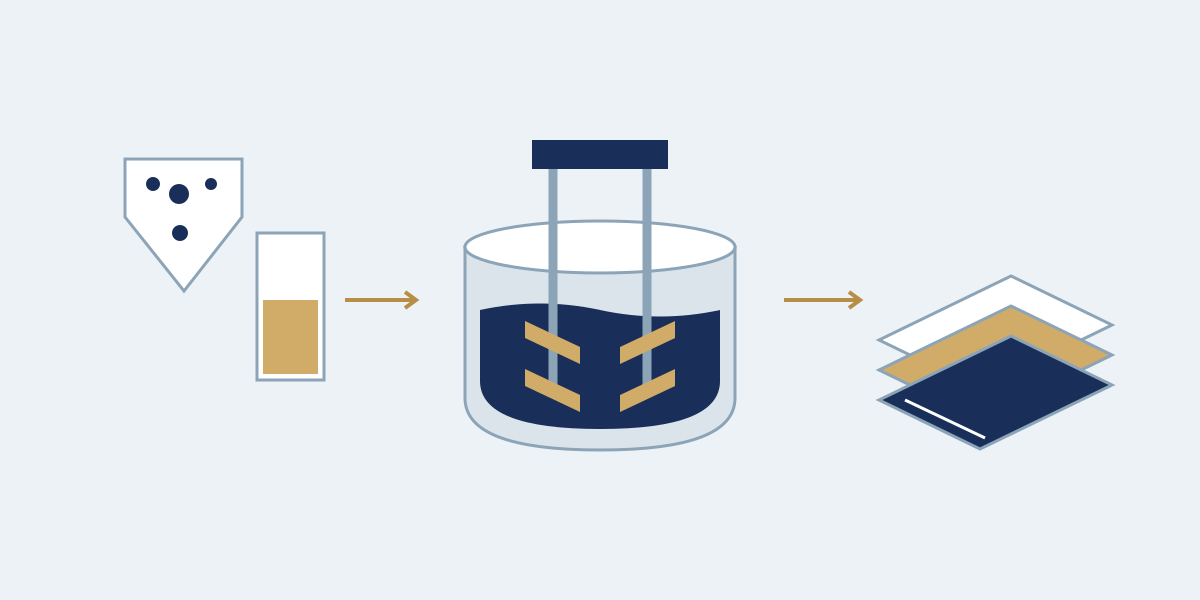
Slurry mixing supplies the material used in electrode coating. A double planetary mixer can be evaluated for combining powder and liquid ingredients when the formulation requires strong bulk movement and configured dispersion.
The mixer is one part of the production process. Slurry quality, coating behavior, and later cell manufacturing also depend on the formulation, handling conditions, and downstream equipment.
Where Mixing Fits in Battery Manufacturing
Yushun's domestic article places mixing in the early electrode-manufacturing stages, alongside batching and before coating. Later processing includes electrode finishing and cell assembly, with the detailed route depending on the battery design.
This position makes the slurry specification an important interface between formulation development and production. Define what the coating process requires before selecting the mixing equipment.
Three Slurry Quality Questions
Are the Ingredients Uniformly Dispersed?
Check distribution and the relevant fineness or agglomerate measurements using an agreed method. A visually uniform slurry is not sufficient evidence that every quality requirement has been met.
Does the Composition Match the Recipe?
The source article identifies solids content as a key measure. Charging accuracy and the addition sequence should support the approved formulation; the mixer cannot compensate for an incorrect recipe or charge.
Is the Slurry's Flow Behavior Suitable?
Viscosity is another important measure in the domestic article. Evaluate it at defined conditions and consider the stability required between mixing, storage, transfer, and coating.
Bulk Mixing and Localized Dispersion
Planetary tool motion supports movement through the batch. Where configured, a high-speed disperser adds localized action for powder wetting and dispersion. These functions should be coordinated with the formulation and each recipe stage.
The required speed, time, temperature control, and vacuum conditions need to be established through material trials. Successful mixing does not on its own guarantee finished-cell consistency or performance.
From Laboratory Work to Production
The source article describes laboratory, pilot, and production equipment. Choose the working batch and scale-up approach for the material rather than copying a historical model-volume grouping as a current series limit.
Compare laboratory and pilot results with the same measurements. Record the formulation, addition sequence, operating conditions, temperature, and batch outcome so the production configuration can be reviewed against useful data.
Plan the Transfer Interface
Yushun's source describes transferring mixed slurry through intermediate and coating-side vessels. Define the actual transfer route, buffering, pump selection, sampling, and holding conditions with the downstream process team.
Mixing and transfer should be assessed together. Material behavior at discharge may differ from its behavior after storage or pumping, so include those stages in the agreed quality checks.
Review the double planetary mixer, battery slurry application, and slurry processing solution. The mixer selection guide lists useful inquiry inputs. Discuss your electrode slurry process with Yushun.
Adapted from Yushun's domestic battery slurry mixing article, displaying July 10, 2024. English edition prepared October 14, 2026. Engineering review is required for the translation, configuration, and acceptance criteria.
Engineering consultation
Need Help With Your Process?
Tell our engineers about your material, target particle size, viscosity, capacity, and production goals.