
Technical Articles
Understanding Automated Battery Slurry Preparation
Follow the interfaces between ingredient dosing, staged slurry mixing, transfer, filtration, and optional homogenization in an automated electrode slurry system.
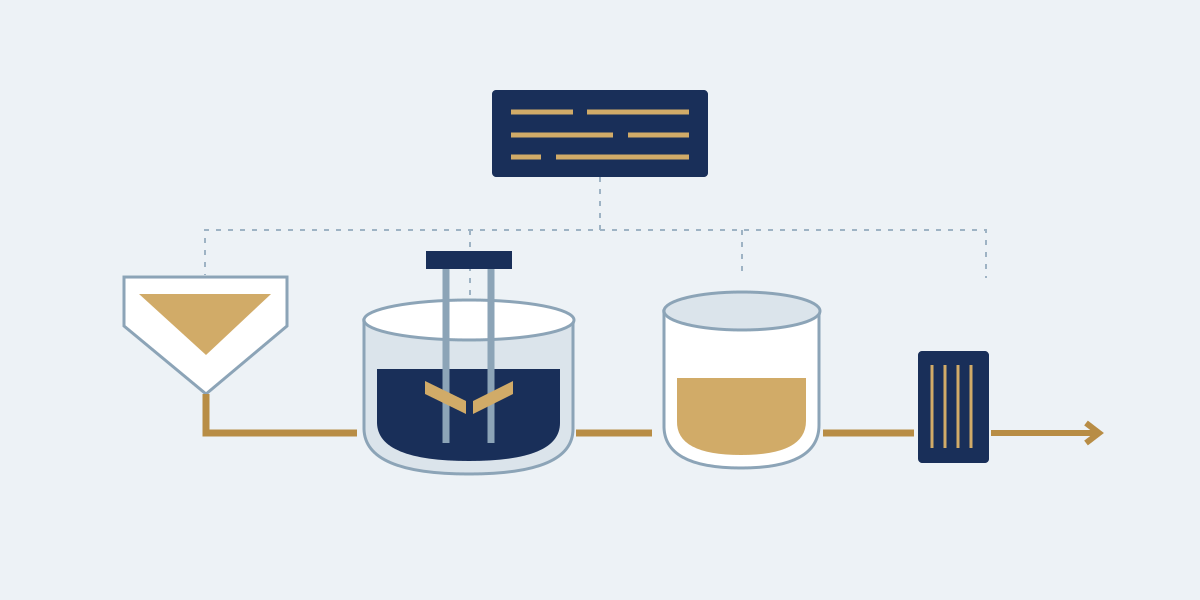
An automated electrode slurry system coordinates ingredient delivery, mixing, and the supply of prepared slurry to coating. Its usefulness depends on the material and the interfaces between those stages, not only on whether the individual machines have automatic controls.
Yushun's domestic article describes three main parts: material delivery, slurry preparation, and slurry transfer. The sequence below explains these interfaces while leaving recipe-specific choices to the project.
1. Ingredient Storage, Transfer, and Dosing
The system must deliver the specified powders, liquids, solvents, and binder ingredients to the process in controlled quantities. The source describes weighing, powder charging and transfer, central controls, storage, and buffer vessels.
Powder properties such as particle condition and bulk density affect the transfer and dosing arrangement. Cathode and anode systems may have similar stages but require different configurations for their materials.
Define the weighing basis, accuracy criteria, charging sequence, containment needs, and interfaces to storage and the mixer. Closed handling should be evaluated for the actual environmental and material-protection requirements; it is not a universal guarantee against contamination or material change.
2. Dry Premixing and Binder Preparation
For recipes that use dry premixing, the purpose is to distribute powder components before a later mixing stage. Different ingredients have different particle sizes and bulk behavior, so the sequence and motion should be established using representative material.
The domestic article also describes preparing binder solution separately before it is added to the mixer. Whether dry premixing or a separate binder system is appropriate depends on the formulation; neither should be imposed on every slurry recipe.
3. Mixing, Kneading, and Composition Adjustment
Where the process includes a viscous kneading stage, mechanical action works the mixture as ingredients are incorporated. Later liquid addition may adjust viscosity and solids content according to the approved recipe.
Record the ingredient sequence, stage conditions, temperature, and relevant mixing measurements. Review the double planetary mixer and battery slurry mixing principles when defining the required action.
A sequence that performs well at laboratory scale still needs an appropriate production evaluation. Automation should reproduce an established process window rather than hide an unverified mixing procedure.
4. Transfer, Filtration, and Buffering
The source describes transfer pumps, filters, storage vessels, and dispersion equipment. Choose the pump and transfer route for slurry behavior and the delivery stability required by coating.
Filter selection balances removal of unwanted large particles against flow and pressure requirements. Define filtration criteria with the slurry and coating teams; no single filter size is appropriate for all formulations.
Buffer capacity, holding conditions, sampling, and transfer after storage should be included in the evaluation. The slurry's quality needs to remain suitable at the point where it is supplied to the next stage.
5. Evaluate Homogenization Where the Recipe Requires It
The domestic article describes high-pressure homogenization as a finishing approach. Whether additional homogenization is needed, where it belongs in the route, and which technology is appropriate require material testing.
Do not assume that every electrode slurry must pass through a high-pressure homogenizer. Review the effect on the formulation and temperature, and compare the outcome with the agreed quality criteria.
Define the Whole-System Acceptance Boundary
Before specifying automation, agree on ingredient controls, recipe stages, instrument scope, equipment interfaces, batch records, sampling, cleaning, and the responsibility for installation and commissioning.
The acceptance plan should cover the complete material path from charging to the coating supply interface. Component data alone does not establish the performance of the integrated line.
Explore the lithium battery slurry processing solution, the battery slurry application, and the mixer selection guide. Send your system requirements for a project-specific discussion.
Adapted from Yushun's domestic automated slurry preparation article, displaying July 10, 2024. English edition prepared October 14, 2026. Technical translation, recipe stages and final system scope require engineering review.
Engineering consultation
Need Help With Your Process?
Tell our engineers about your material, target particle size, viscosity, capacity, and production goals.